Curriculum
Clinical Certificate in
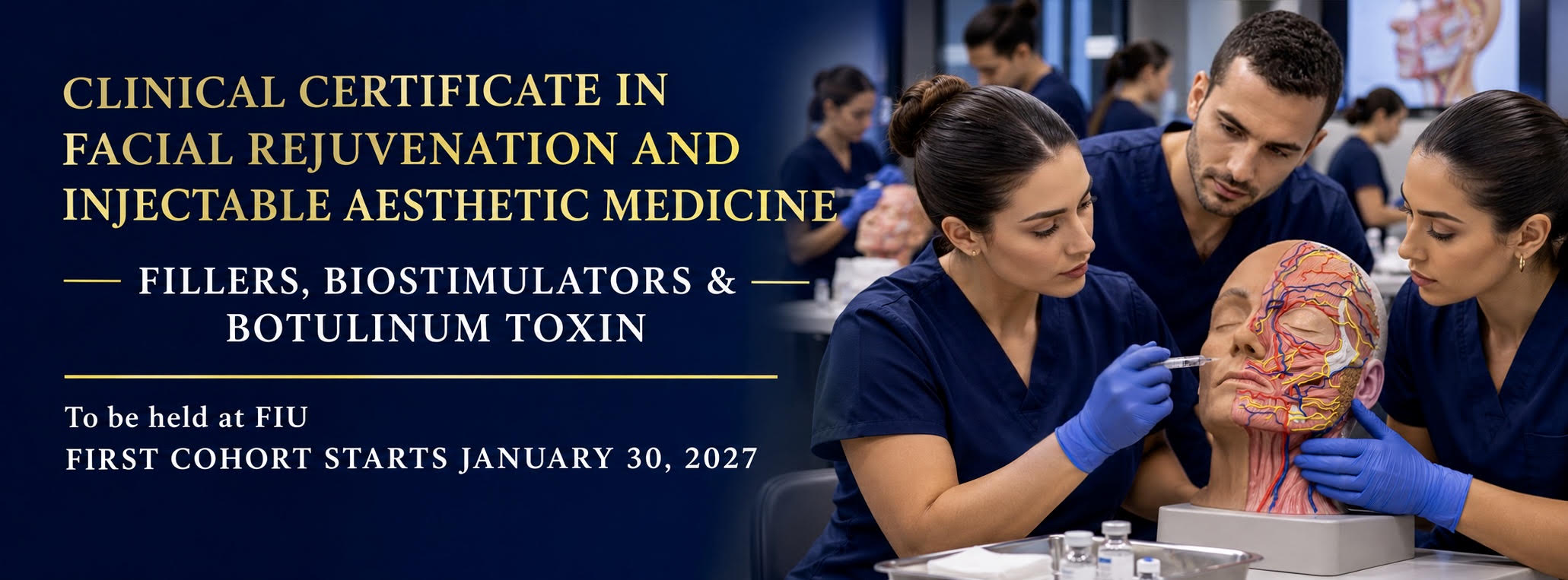
Facial Rejuvenation and Injectable Aesthetic MedicineFillers, Biostimulators & Botulinum Toxin
A structured, competency-based program that moves from science and anatomy to supervised live-patient practice, in that order. Every injectable is taught only after the anatomy and safety foundations that make it safe.
Designed for licensed physicians, dentists, physician assistants (PAs), and nurses
How You'll Learn
Business and legal, compliance, social media marketing, insurance, psychology, patient assessment. Didactic instruction in anatomy, product science, clinical reasoning, safety and professional practice.
Simulation laboratory with mannequin practice, cadaver lab with human cephalic specimens, supervised live-patient practice where you learn, practice and observe 15+ different injectable procedures, and a practical competency assessment.
Earn 40 hours of CME credit for designated portions of the program, jointly provided by FIU Herbert Wertheim College of Medicine, an ACCME-accredited provider.

College of Medicine
This activity has been planned and implemented in accordance with the accreditation requirements and policies of the Accreditation Council for Continuing Medical Education (ACCME) through the joint providership of Florida International University Herbert Wertheim College of Medicine (FIU HWCOM) and Boribana Medical Training (BMT). FIU HWCOM is accredited by the ACCME to provide continuing medical education for physicians.
The 8 Saturdays
Saturdays only. Keep your practice running while you train.
Saturday 1 is where you start building a practice, not just a skill set. Before you treat a single patient, you will learn to think like an aesthetic clinician, protect your license, and understand what it takes to open and grow your own aesthetic practice.
Highlights of the day
Program orientation and competency-based education, patient-centered practice, critical thinking, observation vs. interpretation, and clinical problem identification.
Scope of practice, malpractice insurance and the steps that protect your license in aesthetic medicine.
The permits, licenses and documents you need to set up and operate an aesthetic practice.
How to approach each patient, manage expectations and identify body dysmorphic disorder (BDD) before you treat.
How to attract the right patients and build your aesthetic practice ethically and professionally.
Key aesthetic medicine industry statistics, plus how to present treatment plans, price your services and turn consultations into loyal patients.
Legal content is presented as an educational framework; regulations vary by state and territory.
Every safe injection begins with knowing exactly what lies beneath the needle. Saturday 2 builds a three-dimensional understanding of the face and maps where danger lies, then takes you into the cadaver lab with human cephalic specimens to see and touch it for yourself.
Highlights of the day
Work directly with human cephalic specimens, guided by faculty, layer by layer from skin to bone.
Trace the arteries and veins of the face, their connections to the eye and brain, and the high-risk zones every injector must know.
Facial skeleton, retaining ligaments, fat compartments and muscles of expression, and why each plane matters for product placement.
Locate the facial and sensory nerves, the parotid gland and the fascial layers relevant to every injection.
See how much real anatomy varies from one face to the next, so no two patients are treated as identical maps.
Connect what you see in the lab to surface landmarks on a living face, turning anatomy into confident, safe injection decisions.
Treating aging well starts with understanding how it actually happens. Saturday 3 teaches you to read the aging face layer by layer, then introduces biostimulators and the judgment to know when, and for whom, they are the right choice.
Highlights of the day
Bone resorption, ligament laxity, fat loss and skin changes, understood layer by layer.
Proportion and harmony, volume loss vs. descent, dynamic vs. static changes, practiced through case-based analysis in the lab.
How poly-L-lactic acid and calcium hydroxylapatite stimulate collagen, and how tissue responds over time.
Indications, contraindications and precautions, realistic objectives and potential complications.
Botulinum toxin is the most widely performed aesthetic treatment, and great results depend on understanding the muscles behind every expression. Saturday 4 takes you from the science to facial mapping, treatment planning and simulated technique.
Highlights of the day
Mechanism at the neuromuscular junction, onset and duration, and the principles of reconstitution, dilution and handling.
Muscles of facial expression, their agonist–antagonist balance, and how to analyze dynamic movement.
Glabella, forehead, lateral canthal lines and selected lower-face areas, with facial mapping and treatment planning.
Injection technique in simulation, and how to prevent and manage complications such as ptosis and asymmetry.
Not all fillers are the same, and choosing the right one starts with understanding the material itself. Saturday 5 covers the science of hyaluronic acid, then applies it region by region with a step-by-step decision process and simulated technique.
Highlights of the day
Classification, crosslinking and rheology: elasticity, viscosity, cohesivity and hydrophilicity.
How to match each product to its indication, and how fillers integrate and biodegrade in tissue.
Temple, midface, perioral area, jawline and chin, following a step-by-step path from aging problem to product, plane, instrument, risk and strategy.
Asepsis, consent, documentation and contraindications, followed by facial marking and simulated filler technique.
Knowing how to inject is only half the job; knowing whom to treat, what to treat and when not to treat is the other half. Saturday 6 builds a complete patient assessment and closes with a focused session on complications.
Highlights of the day
Medical and aesthetic history, medications, prior procedures and expectations, plus static, dynamic and skin assessment.
Risks, contraindications and priorities, with complete treatment plans built for standardized patient cases.
Informed consent, standardized clinical photographs and documentation at every step.
Prevention strategies and early recognition of vascular and infection-related events, with ethical patient selection and no overtreatment.
This is the day the program moves from practice to patients. After an integrated simulation lab, you treat your first live patients under the direct supervision of faculty.
Highlights of the day
Botulinum toxin, hyaluronic acid filler and biostimulator scenarios combined into complete cases, including complication recognition.
Treat real patients for the first time, under the direct supervision of faculty.
Explain your clinical reasoning and treatment plan before you treat.
Consent, patient preparation, a supervised procedure, documentation and clear post-treatment instructions.
The final Saturday is entirely hands-on. You treat live patients with growing independence, then complete a practical competency assessment: the final safety gate to earn your certificate.
Highlights of the day
Treat live patients with increasing autonomy, always under direct faculty supervision.
Patient selection, assessment, product choice, technique and aftercare.
Work through a complex case, including risk assessment and treatment planning.
The practical safety gate every student must pass to earn the certificate.
Saturday 8 is fully hands-on: plan to be present for the entire 7-hour day.
What's Included
One tuition. Everything you need to train, practice and certify.
Tuition & Payment Options · Limited Seats
Invest in your clinical future
Option 1 · Best price
Bank Transfer
$18,900Save $800
One-time payment via ACH
- Pay directly from your U.S. bank account with a secure invoice
- Your seat is confirmed once the transfer clears
- Includes BMT Clinical Certificate scrubs and all course materials
Option 2 · Pay online
Credit or Debit Card
$19,700
Earn your card's rewards points
- Visa, Mastercard, Amex, Discover, Apple Pay, or Google Pay
- Secure online checkout in minutes
- Includes BMT Clinical Certificate scrubs and all course materials
Option 3 · Most flexible
BMT Payment Plan
$4,975/mo
4 monthly payments · $19,900 total
- Financed directly by BMT, with no third-party lender
- Your first payment reserves your seat
- Includes BMT Clinical Certificate scrubs and all course materials
Seats are limited and are confirmed in order of payment. Apply first, then choose your payment option.
Apply Now →Frequently Asked Questions
Licensed physicians, dentists, physician assistants (PAs), and nurses holding a valid, active license, including MD, DO, DDS, DMD, PA, NP, CRNA, and RN. The program is designed both for clinicians who are new to aesthetic medicine and for experienced injectors.
No. The program moves step by step from science and anatomy to supervised live-patient practice, so it is ideal for injectors of all levels, from novice to expert.
On campus at FIU Herbert Wertheim College of Medicine in Miami, Florida, over 8 Saturdays. The next cohort runs January 30 – March 20, 2027.
A multidisciplinary BMT faculty of physicians (MDs), Doctors of Dental Surgery (DDS), and nurse practitioners (NPs), trained in the Cardona Method® under the academic direction of Dr. Eduardo Cardona.
This is a post-licensure clinical certificate program for licensed healthcare professionals. It is not an academic degree.
We offer options to pay in full right away, as well as a 4-payment plan financed directly by BMT. You will find all the details in the Tuition & Payment Options section on this page. You must submit the Application for Admission before making a payment.
Only two: a copy of your current professional license and a passport or government-issued ID. Your documents are used only for admission verification and are kept confidential.
50 contact hours over 8 Saturdays; 40 hours of CME credit; cadaver lab with human cephalic specimens; simulation laboratory with mannequin practice; supervised live-patient practice; study materials, including the Top Injector book, signed by its author, Dr. Eduardo Cardona; clinical supplies, consumables and the injectable products used in hands-on training, plus use of professional equipment such as magnifying lamps; your BMT Clinical Certificate scrubs; and a clinical certificate issued by BMT upon successful completion.
Yes. Hands-on training includes a cadaver lab with human cephalic specimens, a simulation laboratory with mannequin practice, supervised live-patient practice where each participant learns, practices and observes 15+ different injectable procedures, and a final practical competency assessment.
Yes. The cadaver lab with human cephalic specimens is included in your tuition. It is a hands-on experience that helps you understand the structures, layers, and danger zones behind every safe injection.
Yes. Every participant receives the BMT Clinical Certificate scrubs, a distinction worn by those enrolled in the program, and the Top Injector book, signed by its author, Dr. Eduardo Cardona, as a special gift from our Program Director. Your tuition also includes study materials and the clinical supplies, consumables and injectable products used in hands-on training, plus use of professional equipment such as magnifying lamps.
Yes. Upon successful completion of all 50 hours and the final practical competency assessment, you receive a clinical certificate issued by Boribana Medical Training (BMT). CME credits are provided separately through joint providership with the host university.
Yes. You receive a CME certificate for 40 hours of continuing medical education, jointly provided by FIU Herbert Wertheim College of Medicine, an ACCME-accredited provider. The full program totals 50 contact hours: 25 hours of didactic sessions and 25 hours of hands-on training.
Complete the online Application for Admission on the Enrollment page. It takes four steps: identification, credentials and documents, experience, and agreements.